Exercising Safely During Ramadan
Dr. Kate Dudek & Dr. Saba Alzabin • May 19, 2019 • 5 min read

The holy month of Ramadan is a time for reflection and commitment to one’s faith. It is also an opportunity to spend time with loved ones, particularly at Iftar when family and friends come together to break their fast and socialise.
Fasting between the hours of sunrise and sunset can be a psychological and physical challenge. It inevitably results in changes to the normal sleep pattern and a disruption to the body’s circadian rhythm. Dehydration is an issue, particularly in countries with a hot climate, and those who are fasting are encouraged to consume plenty of liquids between iftar and suhoor to replenish the lost fluids.
So, at a time when the body is already under increased stress, is it safe to exercise, or should activity be kept to a minimum?
Should I exercise during Ramadan?
The answer may well be a surprise to some, but maintaining a reasonable level of physical activity can actually be beneficial. Experts recommend moderate exercise and explicitly discourage fasting Muslims from adopting too sedentary a lifestyle. Fasting without partaking in any exercise reduces metabolism, as well as physical strength and fitness; keeping active ensues that you stay healthy for the duration of the holy month.
What exercise is recommended?
The type of exercise depends not only on how physically fit you were prior to Ramadan, but also on when you are exercising. Vigorous, high impact exercise is only recommended after futoor, so that you can stay hydrated and replenish your nutrients straight afterwards. During the hours of fasting, high intensity exercises should be avoided as these will increase the amount of fluid lost, which, in turn, increases the risk of dehydration.
Between suhoor and futoor, the best forms of activity include taking a brisk walk, or slow jog, or going for a bike ride. Use exercise machines at a low setting and, if you lift weights, consider reducing the load for the duration of Ramadan. Try to exercise in locations that have air conditioning.
Also, bear in mind that Ramadan is a time when you are more likely to have disturbed sleep patterns, and, as a result, impaired vigilance and slower reaction times and as such you may wish to modify your usual training programme.
When is the best time to exercise?
If you choose to exercise before breaking your fast, aim for light exercises that will not cause you to lose too much body fluid. A good time to exercise is in the hour before iftar; this way your body will soon receive the required nourishment. This is ideal for those who use the breaking of their fast as a time of socialisation to be spent with family. However, if you feel particularly weak or dehydrated, you should avoid exercise until after you have eaten and replenished your blood sugar levels.
If you exercise after iftar, try to wait for 2-3 hours so that your body has had time to digest the food. The advantage to exercising at this time is that you can continue to consume fluids as you work out and therefore, you can engage in heavier exercise. Another advantage is that lost fluids, salts and minerals can all be replaced at the pre-dawn meal, prior to starting the next day’s fast. Problems with exercising at this time, include finding facilities that are open at what would normally be considered to be ‘anti-social’ hours and fitting a workout into your own social schedule. The time between futoor and suhoor is typically quite hectic, involving socialising, eating, praying and sleeping. Depending on geographical location and time of year it may also be quite restricted timewise, so fitting exercise in, as well as everything else, might prove challenging.
If I want to exercise should I modify my diet at suhoor and iftar?
The main thing is to try and maintain a balanced diet at the times that you do eat. Increase your complex carbohydrate intake at suhoor. Eating the right sorts of carbohydrates (peas, whole grains and vegetables) will give slow energy release throughout the day. Avoid simple carbohydrates, such as sugars, fizzy drinks and baked goods, as they are low in nutrients and only provide short-term energy. Also include food with a higher fat content in your pre-dawn meal, as this will slow gastric emptying, meaning it will take longer for you to feel hungry and your body will have accessible energy for longer. Eat a nutritional meal at the break of fast and try to increase your protein intake. Consuming foods that are potassium-rich during iftar is also recommended, as potassium levels fall when body fluids are lost. Foods high in potassium include beans, leafy greens, potatoes and bananas.
Maintaining hydration is essential, at both suhoor and iftar, so consume plenty of water and include foods that have high water content, for example fruits, vegetable, soups and stews.
Will fasting affect my performance?
This question is particularly relevant for athletes, who are keen to maintain their training schedule throughout Ramadan. You may wish to adjust the times at which you train to late at night and early in the morning, and it is also worth considering reducing the intensity of your exercise for the duration of the holy month.
Studies have shown that whilst anaerobic performance reduces during Ramadan, aerobic power and muscle strength do not significantly change. The best way to maintain performance is to monitor your food intake between sunset and sunrise and try to avoid fatigue, by minimising sleep loss.
Whilst keeping active during Ramadan is generally considered to be a positive thing, do take care of yourself. Consult a healthcare professional if you have any concerns and stop exercising immediately if you feel dizzy or nauseous, or experience chest pains.
A big part of Ramadan comes from strengthening the communal spirit; taking the time to pray, eat and talk together as friends and family. Exercise and socialisation do not have to be independent events, for example, great pleasure can be obtained from taking walks as a family, either late at night, or first thing in the morning. Keeping active and healthy will help you observe the holy month and maximise your spiritual development.
Try Nabta’s energy booster and stay healthy
Sources:
- Baqer, H R. “Physical Activity during Ramadan.” Hamad Medical Corporation, Ministry of Public Health, http://www.hamad.qa/EN/your health/Ramadan Health/Health Information/Pages/Activity.aspx.
- Shephard, R J. “Ramadan and Sport: Minimizing Effects upon the Observant Athlete.” Sports Medicine, vol. 43, no. 12, Dec. 2013, pp. 1217–1241., doi:10.1007/s40279-013-0080-7.
Download the Nabta App


Related Articles

The Benefits of Postnatal Physiotherapy
Postnatal exercise can help you recover after childbirth, make you stronger and improve your mood. Even if you’re tired and not feeling motivated, there’s plenty you can do to get your body moving. But no 2 pregnancies are the same. How soon you’re ready to start exercising depends on your individual circumstances. You should always check with a health professional first. When you feel ready to exercise, it’s very important to not overdo it. [Your body](https://www.pregnancybirthbaby.org.au/what-happens-to-your-body-in-childbirth) has been through some big changes. You will need time to recover, even if you’re feeling great after having your baby. **Why should I do pelvic floor exercises after birth?** Pelvic floor exercises are important at all stages of life to prevent bladder and bowel problems, such as incontinence and prolapse, and improve sexual function. Your [pelvic floor](https://www.pregnancybirthbaby.org.au/anatomy-of-pregnancy-and-birth-perineum-pelvic-floor) is a group of muscles which support your bladder, [](https://www.pregnancybirthbaby.org.au/anatomy-of-pregnancy-and-birth-uterus)[uterus](https://nabtahealth.com/glossary/uterus/) and bowel. These muscles form a ‘sling’ which attaches to your pubic bone at the front and your tailbone at the back. Your urethra, [vagina](https://nabtahealth.com/glossary/vagina/) and anus, all pass through the pelvic floor. In pregnancy, hormonal changes cause your muscles to soften and stretch more easily. These changes, along with the weight of your growing baby, put extra strain on the pelvic floor. Labour and birth can also weaken your pelvic muscles. This can increase the chance of suffering from [bladder or bowel problems](https://www.pregnancybirthbaby.org.au/bladder-and-bowel-problems-during-pregnancy) during pregnancy and after birth. Gentle exercise to restore your pelvic health is the best way to begin and you can gradually increase the intensity [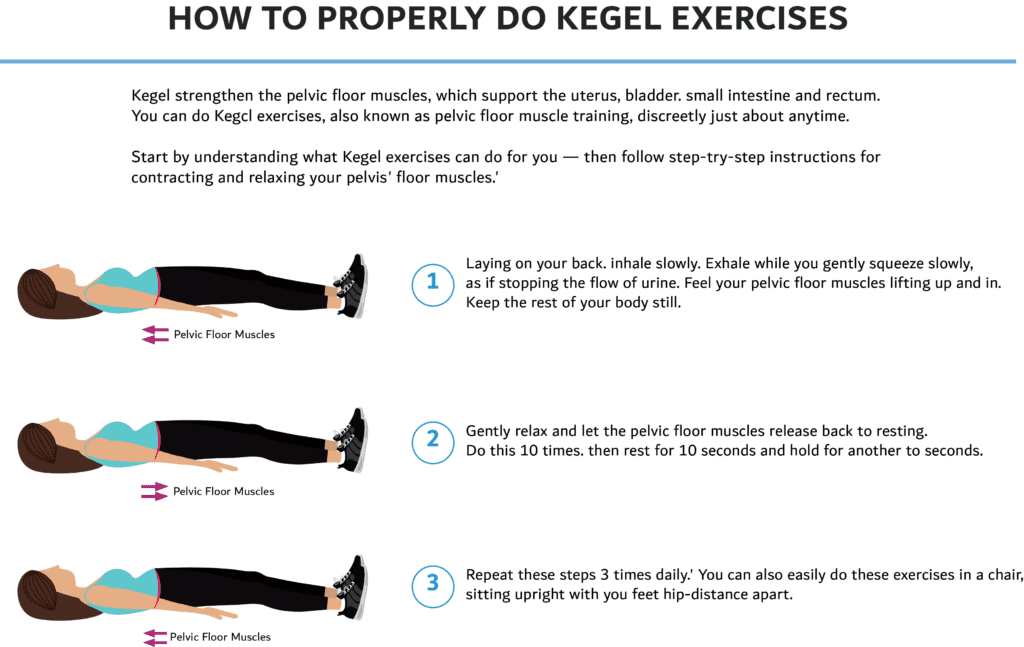](https://nabtahealth.com/wp-content/uploads/2023/03/Kegel-Exersices-PNG-1024x647-1.png) **What type of exercises can I do?** Do More: 1. Gentle exercise such as walking can be done as soon as you feel comfortable after giving birth 2. Start with easy exercises and gentle stretches and slowly build up to harder ones 3. Other safe exercises include swimming (once bleeding has stopped), yoga, pilates, low impact aerobics and cycling Avoid: 1. Any high intensity exercises or sports that require rapid direction changes 2. Stretching and twisting too vigorously to prevent injury 3. Heavy weights, sit ups, crunches and planks for 3 months #### Goals of a well designed Postpartum Exercise program 1. Rest and recover 2. Maintain good posture and alignment 3. Rehabilitate the pelvic floor muscles 4. Increase strength especially in the core muscles At Nabta Health Clinic, we have specialized exercise packages which include pelvic floor rehabilitation and pilates exercise program for pregnancy and the postnatal period to help you in your well being and recovery. Nabta is reshaping women’s healthcare. We support women with their personal health journeys, from everyday wellbeing to the uniquely female experiences of fertility, pregnancy, and [](https://nabtahealth.com/glossary)[menopause](https://nabtahealth.com/glossary/menopause/). You can [email us](/cdn-cgi/l/email-protection#235a424f4f42634d424157424b46424f574b0d404c4e) or call us at **+971 4 3946122** for more information

What is the best type of yoga for me – Hatha, Vinyasa, Ashtanga?
Many people practice yoga and advocates of it will be quick to promote the many associated health benefits. So, what is yoga; what are the different types of yoga; and is their merit in the many health claims made? **What is yoga?** ----------------- Yoga is an ancient and complex practice that originated in India more than 2000 years ago. Performed correctly, it encompasses union of the body with the state of consciousness, using physical postures (asanas), breathing techniques (pranayama), relaxation and meditation (dyana). It can take years to become proficient at performing some of the more complex moves; however, it is a form of exercise that can be adapted for all people, at all stages of life. It increases mindfulness and is claimed to improve both mental and physical health. **The different types of yoga** ------------------------------- If new to the yoga experience, the many different types might seem confusing. It is true, yoga comes in many guises, with names that are unfamiliar to many of us. However, there are similarities between the different types and perhaps by knowing the basics, you will be better placed to pick a style that is best suited for you. The below list is not exhaustive and some instructors may take a slightly flexible approach, encompassing different styles in their teaching; but, here are some of the most widely known yoga techniques: * **Hatha**. This is a type of yoga that is focused on movement (in fact, many of the subtypes of yoga could be broadly classified as hatha). Participants are encouraged to execute their movements slowly, changing from standing, to sitting, to lying, in both prone and supine positions. Balance is fundamental as the movements predominantly involve remaining static for a period of time, before easing slowly into the next position. Integral yoga is a subtype of hatha that involves the same movements accompanied by chanting and meditation. * **Vinyasa**. This is known as flow yoga as it involves continuous, dynamic movement from one posture to the next. It is faster moving and requires agility and coordination. As such, it may be better suited to those who are more experienced at yoga. It focuses on sun salutations (suryanamaskar) and the matching of one’s breathing to their movements. * **Ashtanga**. This form of yoga was developed in the 1960s. It is a set series of poses that are performed in sequence. It is fast-paced, intense and flowing. It is one of the more physically demanding forms of yoga, requiring constant movement and regular practice. * **Iyengar**. In this type of yoga, each position is held for a period of time, with the emphasis being on proper alignment and good posture throughout. It can be used for rehabilitation after injury. * **Bikram/hot yoga**. A more recent addition to the yoga family, but very popular worldwide; this type of yoga involves a sequence of 26 hatha yoga postures combined with breathing exercises. It is performed in a temperature/humidity controlled environment at 35-42°C heat with 40–60% relative humidity. Advocates claim that the increased temperature loosens tight muscles and encourages the removal of toxins with enhanced sweating. Scientific studies struggle to find additional health-related benefits to this form of yoga, when compared to that performed at room temperature. * **Jivamukti**. This is a physically intense form of yoga that combines ashtanga moves with chanting and periods of meditation. A session will often be focused around an inspirational theme and will include spiritual teachings. * **Kundalini**. This type of yoga focuses on combining breathing techniques with specific physical movements. * **Viniyoga**. This is an individualised approach to applying yoga teachings. Movements are adapted to suit each participant, depending on their stage of life and health status. * **Yin yoga**. In direct contrast to those styles of yoga that are movement-oriented, this style involves holding poses for several minutes. The aim is to prepare the body to sit for a prolonged period of time in contemplative meditation. **Can yoga improve my health?** ------------------------------- This question is surprisingly difficult to answer. There are many reported health benefits to undertaking yoga and those that practice it regularly, claim relief from a whole range of physical and emotional conditions. However, the evidence is surprisingly limited; very few studies have been performed, and those that have, are frequently poorly designed, making it a challenge to draw meaningful conclusions. The conditions that yoga is said to improve include: * Stress * [](https://nabtahealth.com/i-cant-sleep-what-causes-insomnia-and-how-can-you-improve-your-sleep-quality/)[Insomnia](https://nabtahealth.com/glossary/insomnia/) * Anxiety. Although this relates to coping with life situations, rather than medically diagnosed anxiety disorders, such as depression and PTSD. * Diabetes/glucose tolerance * [Hypertension](https://nabtahealth.com/glossary/hypertension/) * Neurodegeneration * Coronary heart disease * Chronic pain, specifically, that affecting the lower back. It is claimed that yoga can help reduce obesity, by encouraging better eating habits and increasing the levels of physical activity. There is an association between yoga and lower [](https://nabtahealth.com/what-is-body-mass-index-bmi/)[BMI](https://nabtahealth.com/glossary/bmi/). People have also claimed that yoga has helped them to stop smoking by reducing their craving for a cigarette. It has been found to reduce some of the more difficult symptoms of the [menopause](https://nabtahealth.com/glossary/menopause/), such as [hot flushes](https://nabtahealth.com/glossary/hot-flushes/) and is recommended by some doctors as a non-drug approach to managing pain. Cancer patients, particularly those with breast cancer, use yoga to improve their [quality of life](https://nabtahealth.com/five-ways-to-counteract-the-loneliness-of-cancer/). Certainly, there is little to be lost by adding yoga to your routine. It comes with few risks (perhaps there are slightly more with Bikram yoga) and anecdotal evidence suggests that it can be very beneficial to a person’s state of mind as well as their physical wellbeing. Nabta is reshaping women’s healthcare. We support women with their personal health journeys, from everyday wellbeing to the uniquely female experiences of fertility, pregnancy, and [menopause](https://nabtahealth.com/glossary/menopause/). Get in [touch](/cdn-cgi/l/email-protection#eb928a87878aab858a899f8a838e8a879f83c5888486) if you have any questions about this article or any aspect of women’s health. We’re here for you. **Sources:** * Cramer, Holger, et al. “Yoga for Improving Health-Related Quality of Life, Mental Health and Cancer-Related Symptoms in Women Diagnosed with Breast Cancer.” Cochrane Database of Systematic Reviews, 3 Jan. 2017, doi:10.1002/14651858.cd010802.pub2. * Grabara, Małgorzata. “Could Hatha Yoga Be a Health-Related Physical Activity?” Biomedical Human Kinetics, vol. 8, no. 1, 22 Feb. 2016, pp. 10–16., doi:10.1515/bhk-2016-0002. * Hunter, Stacy D., et al. “Effects of Yoga Interventions Practised in Heated and Thermoneutral Conditions on Endothelium-Dependent Vasodilatation: The Bikram Yoga Heart Study.” Experimental Physiology, vol. 103, no. 3, 18 Jan. 2018, pp. 391–396., doi:10.1113/ep086725. * Mohammad, Ashu, et al. “Biological Markers for the Effects of Yoga as a Complementary and Alternative Medicine.” Journal of Complementary and Integrative Medicine, vol. 16, no. 1, 7 Feb. 2019, doi:10.1515/jcim-2018-0094. * “Yoga: What You Need To Know.” National Center for Complementary and Integrative Health, U.S. Department of Health and Human Services, 15 May 2019, [https://nccih.nih.gov/health/yoga/introduction.htm](https://nccih.nih.gov).

Why is exercise important if you are trying to gain weight?
It seems counterintuitive, doesn’t it? Exercising to gain weight, when everything we are taught, the dominant narrative focuses on exercising to lose weight. But this misses an important understanding of how our bodies function most effectively. We exercise for physical and mental health, to gain or lose weight healthily and safely, and for lasting benefit. #### _Why do underweight people need to gain weight?_ Firstly, let’s look at why a person might need gaining weight: – After **surgery** or an **illness** to support healthy recovery. – Being underweight can affect a person’s **fertility** and a woman’s ability to get pregnant. – Persistent low weight can cause **developmental problems** or **preventable health conditions**. #### _Why is healthy weight gain important?_ A person is underweight if their [Body Mass Index (](https://www.cdc.gov/healthyweight/assessing/index.html)[BMI](https://nabtahealth.com/glossary/bmi/)) is less than 18.5. We calculate [BMI](https://nabtahealth.com/glossary/bmi/) using [height and weight](https://nabtahealth.com/articles/what-is-body-mass-index-bmi/), dividing a person’s weight in kilograms with their height in metres squared to get an estimate of body fat. Being underweight increases the risk of suffering from health conditions including fragile bones and [osteoporosis](https://nabtahealth.com/glossary/osteoporosis/), weakened immune system, and malnutrition. It also reduces muscle strength and puts a person at greater risk of developing infections. #### _Eat more and build lean muscle growth to gaining weight_ If you’re trying to gain weight your calorie intake should be as nutrient-rich as possible. Eat three to five decent meals a day, with healthy snacks between meals. Increase your carbohydrates, focusing on whole grain breads and cereals. Consume high fat content foods like avocados and nuts and avoid fatty junk foods. Complement higher calorie intake with regular targeted exercise. Strength and resistance training helps build muscle mass which in turn helps with healthy weight gain. Resistance training includes using your body weight (squats, press-ups, bench-presses), resistance bands, classic strength training with free weights, and weight machines. Pilates and yoga count as resistance training too. Exercise also stimulates appetite. Obviously, avoid the temptation to tuck into sugary snacks and fizzy drinks. You want muscle gain, not fat gain. Healthy, lean weight gain is a process that can take many months. Be patient and try to stay consistent. #### _Talk to a professional about safe, healthy weight gain_ It’s important to see your doctor before trying to gain weight. They will want to assess you for any underlying health issues (for example an [overactive thyroid is linked with low weight](https://www.nhs.uk/live-well/healthy-weight/managing-your-weight/advice-for-underweight-adults/)) or medical conditions and discuss an appropriate and healthy weight gain program. Similarly, talk to an exercise professional about your weight gain goals . An exercise physiologist, physiotherapist, personal trainer, or gym instructor will make sure the exercises you are doing help you to safely put on the pounds. #### _Some dos and don’ts for exercising to gaining weight_ – _Don’t_ be tempted by products, supplements, and powders that claim to increase muscle. They can cause unpleasant side effects and [lead](https://nabtahealth.com/glossary/lead/) to unhealthy weight gain. – _Don’t_ snack on fatty junk foods to increase your calorie count. These will only cause fat build-up. – _Do_ eat ‘good’ high fat foods like avocados, nuts, cheese, and fatty fish. – _Do_ increase your nutrient-rich calorie intake. – _Do_ see your doctor before trying to gain weight. – _Do_ talk to a professional exercise physiologist or personal trainer. Remember, gaining weight should be part of a holistic plan for your whole body. It’s true that if you eat more calories than your body uses you will put on weight. But if a person doesn’t train correctly and regularly, they will simply put on fat not muscle and potentially cause unwanted health conditions. Plus, regular activity equals a healthy body and mind, and you can’t argue with that.