Menstrual cups have gained popularity in recent years as a sustainable and cost-effective alternative to traditional menstrual products. Made of medical-grade silicone or latex, these reusable cups collect menstrual fluid rather than absorbing it, offering numerous benefits for those who choose to use them. If you’re new to menstrual cups and considering making the switch, this beginner’s guide will provide you with essential information to help you get started. #### What is a menstrual cup? A menstrual cup is a bell-shaped device designed to collect menstrual fluid. It is inserted into the [vagina](https://nabtahealth.com/glossary/vagina/), where it forms a seal and collects the flow, holding much more liquid than a tampon or pad. The cup is reusable, offering a more sustainable option compared to disposable products. #### Advantages of menstrual cups: **Eco-friendly:** Menstrual cups reduce waste as they can last for several years with proper care. By using a cup, you can significantly decrease the number of disposable pads and tampons that end up in landfills. **Cost-effective:** Although menstrual cups have a higher upfront cost than disposable products, they are a long-term investment. Over time, using a menstrual cup can save you money since you won’t need to regularly purchase [pads or tampons](https://nabtahealth.com/articles/what-type-of-sanitary-product-is-right-for-me/). **Extended wear time:** Unlike pads and tampons, which typically require changing every few hours, menstrual cups can be worn for up to 12 hours, depending on your flow. This makes them convenient for overnight use and allows for uninterrupted activities during the day. **Lower risk of leaks and odor:** When inserted correctly, menstrual cups create a secure seal that reduces the risk of leaks. Additionally, since the fluid is collected rather than absorbed, menstrual cups do not cause the same odor issues that can arise with other products. **Health benefits:** Menstrual cups are made of hypoallergenic materials, making them suitable for people with sensitive skin or allergies. They also do not disrupt the natural pH balance of the [vagina](https://nabtahealth.com/glossary/vagina/), reducing the risk of infections. #### How to use a menstrual cup: **Choosing the right cup:** Menstrual cups come in different sizes and shapes. Consider factors such as your age, flow, [cervix](https://nabtahealth.com/glossary/cervix/) position, and whether you’ve given birth when selecting the appropriate cup. It may take some trial and error to find the perfect fit. **Sterilize the cup:** Before using a menstrual cup for the first time, sterilize it by boiling it in water for a few minutes. Ensure the cup is clean and dry before insertion. **Insertion:** Wash your hands thoroughly. Fold the cup using one of the various folding techniques available. Insert the cup into your [vagina](https://nabtahealth.com/glossary/vagina/), aiming towards the base of the spine. The cup will unfold and create a seal against the vaginal walls. **Removal:** To remove the cup, wash your hands and find a comfortable position. Gently pinch the base of the cup to break the seal, then carefully pull it out. Empty the contents into the toilet, rinse the cup with water, and reinsert if desired. #### Caring for your menstrual cup: **Empty and clean the cup:** Depending on your flow, you may need to empty the cup every 4 to 12 hours. Rinse it with water or wipe it with unscented, mild soap. Sterilize the cup between cycles by boiling it for a few minutes. **Store properly:** Keep your menstrual cup in a breathable bag or container when not in use. Avoid storing it in an airtight or plastic container to prevent odor and bacterial growth. Menstrual cups offer a sustainable, [cost-effective](https://www.lizzom.com/collections/lizzom-products), and convenient alternative to traditional menstrual products. While there may be a learning curve when initially using them, many people find them comfortable and reliable once they get accustomed to the process. By following the tips and techniques outlined in this beginner’s guide, you’ll be well on your way to a more sustainable and hassle-free period experience.

Sanitary pads are recognised worldwide. They are a [menstrual hygiene product](https://nabtahealth.com/what-type-of-sanitary-product-is-right-for-me/), designed for use by women during their monthly periods and also known as sanitary napkins or sanitary towels. #### **From simple beginnings…..** Sanitary pad designs in the 1960s incorporated flexible, thin, leak-proof polyethylene as the back sheet. Over time, sticky, elastic plastics were used, allowing the sanitary pads to be attached to a woman’s underwear directly, rather than hanging off a belt-type device. Later in the 1970s, designers grasped the idea of making plastic “wings” to be used to wrap around panties and place the pad exactly where it is required. #### **……to widespread use in the 21st century** Which brings us, more or less, to the present day, where sanitary pads are still very widely used globally by women during their monthly periods. They can also be used after childbirth when it is normal to have vaginal bleeding for a week or two. In fact, any flow of blood from the [vagina](https://nabtahealth.com/glossary/vagina/) can be easily absorbed and contained within a sanitary pad. Many young women choose to use sanitary pads when they initially start their periods, as it can take time to develop the confidence to use a [tampon](https://nabtahealth.com/what-are-tampons/). Today’s sanitary pads are produced from various materials, based on the brand, country of origin, and even style of pad. #### **How to use sanitary pads** Sanitary pads are worn externally, unlike menstrual cups and tampons that are worn internally. Sanitary pads should be changed regularly, depending on the period flow, i.e. how light or heavy the bleeding is. Provided the right absorbency of the pad is selected, leakage should not occur, meaning menstrual blood does not reach clothing and furnishing Sanitary pads are wrapped individually for easier usage and can be easily carried in your purse. #### **A pad for every flow type** Some of the most common types of pad are: • Regular: it is a middle-range sponginess pad. • Maxi/Super: A spongy bumper pad routinely used by women with heavy periods. • Overnight pads: Longer than regular pads, allowing more protection while lying down.Suitable for use during the night. • Maternity pads; Longer and thicker than maxi/super pads. Designed for women to use after childbirth, can also absorb urine. • Ultra-thin: A thin pad that may be as spongy as a Maxi/Super or Regular pad, but with a reduced amount of bulkiness. It is important to remember that, regardless of type, sanitary pads cannot be flushed down the toilet as they might cause a blockage. #### **The environmental impact of disposable sanitary pads** Establishing exactly how much plastic waste comes from sanitary pads is tough, as it is labeled as medical refuse. The plastic used in sanitary pads is not eco-friendly and can [lead](https://nabtahealth.com/glossary/lead/) to environmental and health hazards as one pad takes hundreds of years to decompose. An increased environmental awareness is one reason why, recently, women have been looking for alternative, more eco-friendly sanitary products. [Reusable pads](https://nabtahealth.com/the-use-of-reusable-sanitary-pads-in-sub-saharan-africa/) and washable [menstrual cups](https://nabtahealth.com/what-are-menstrual-cups-and-why-are-they-growing-in-popularity/) are both becoming more widely used. Both have actually been in existence for a long time, but improved designs make them a viable alternative for the modern woman. Nabta is reshaping women’s healthcare. We support women with their personal health journeys, from everyday wellbeing to the uniquely female experiences of fertility, pregnancy, and [menopause](https://nabtahealth.com/glossary/menopause/). Get in [touch](/cdn-cgi/l/email-protection#1960787575785977787b6d78717c78756d71377a7674) if you have any questions about this article or any aspect of women’s health. We’re here for you. **Sources:** * “How Tampons and Pads Became so Unsustainable.” _National Geographic_, 18 Oct. 2019, [www.nationalgeographic.com/environment/2019/09/how-tampons-pads-became-unsustainable-story-of-plastic/](http://www.nationalgeographic.com/environment/2019/09/how-tampons-pads-became-unsustainable-story-of-plastic/). * “What Is a Sanitary Pad?” _Menstrupedia_, [www.menstrupedia.com/articles/girls/sanitary-pad](http://www.menstrupedia.com/articles/girls/sanitary-pad).

From the time that a female starts her periods when she enters [](https://nabtahealth.com/what-is-puberty/)[puberty](https://nabtahealth.com/glossary/puberty/) until she reaches [](https://nabtahealth.com/about-the-three-stages-of-menopause/)[menopause](https://nabtahealth.com/glossary/menopause/) and stops having periods, menstrual hygiene will become something that she has to carefully consider. Most women menstruate for about 40 years and regular periods are a good indicator that a female is reproductively healthy. Although, unfortunately there are exceptions to this, for example women with [](https://nabtahealth.com/what-is-endometriosis/)[endometriosis](https://nabtahealth.com/glossary/endometriosis/) often have periods that appear normal. As menstruation is such a fundamental part of being a woman of reproductive age, taking the time to explore and sample the available sanitary products can help make periods more manageable. Deciding on which sanitary products to use can be influenced by a range of factors, including: * Cost * Environmental impact * How often the product will need changing throughout the day * Local availability * Heaviness of flow * Personal preference and/or recommendations by friends and family. The range of sanitary products available today means that the majority of women are able to manage their periods safely, comfortably and with dignity; in contrast to days gone by when old rags and sheep wool were commonly used to soak up menstrual blood. **Sanitary pads** ------------------- A common choice for girls who have only just started their periods. [Sanitary pads](https://nabtahealth.com/what-are-sanitary-pads/) are also known as sanitary napkins and sanitary towels. They are narrow pieces of absorbent material that fit directly into the underwear. Easy to use and change, they are available in different absorbencies to suit differing flow rates and times of the day. Some have wings attached to help secure them in place and reduce the risk of stains or leaks. Disposable sanitary pads were first used in the early 1920s, they gave women the opportunity to manage their periods discreetly, as there was no longer the need to wash and dry the bulky homemade versions publicly. Now, with advancements in manufacturing and material availability and a general public who are becoming increasingly environmentally driven, there is renewed demand for reusable sanitary pads, to avoid the high plastic wastage that comes from most disposable variants. [Reusable sanitary pads](https://nabtahealth.com/the-use-of-reusable-sanitary-pads-in-sub-saharan-africa/) are made from new or old materials such as sheets, pillow cases, and towels. They are made from pure cotton, as it is the best material for absorbing and also the most comfortable to wear. **Tampons** ----------- Often preferred over sanitary pads by dancers, athletes and swimmers, [tampons](https://nabtahealth.com/what-are-tampons/) are worn internally. A simple concept, they are devised of a wad of cotton attached to a string. Some come with a plastic applicator for ease of insertion. Once inserted into the [vagina](https://nabtahealth.com/glossary/vagina/), they expand slightly to absorb menstrual blood. They will typically need changing every 4 to 6 hours and, as such, are not ideal for wearing overnight. In the 1980s, an association between tampon use and Toxic Shock Syndrome (TSS) was reported. Whilst the overall risk of developing TSS remained very low, the link between it and tampon use was enough to put some women off using them for prolonged periods of time. Like disposable pads, tampons incur significant plastic waste and many women today strive for alternatives that are more environmentally friendly. **Menstrual cups and disks** ------------------------------ A [menstrual cup](https://nabtahealth.com/what-are-menstrual-cups-and-why-are-they-growing-in-popularity/) is a reusable hygiene product. The cup is made from medical-grade rubber or silicone, it is small and funnel-shaped and is inserted into the [vagina](https://nabtahealth.com/glossary/vagina/), where it forms a seal and collects menstrual blood. There are disposable menstrual cups, but it is the reusable ones that have really been growing in popularity in recent years. The menstrual cup holds up to 38 ml fluid, meaning it requires changing less often than a sanitary pad or tampon; it also has fewer of the negative associations with TSS that tampons have. Whilst it can take a few attempts to master the [art](https://nabtahealth.com/glossary/art/) of insertion, leakage rates are low once the cup is in position. Reusable menstrual cups should be washed and wiped clean before each use and sterilised at the end of your period. Modern menstrual cups are very durable and can last for up to 10 years with proper care. Menstrual disks and cups are similar as both are inserted into the [vagina](https://nabtahealth.com/glossary/vagina/) and both collect blood rather than absorbing it. Disks typically sit higher up, where the [vagina](https://nabtahealth.com/glossary/vagina/) meets the [cervix](https://nabtahealth.com/glossary/cervix/) (the [vagina](https://nabtahealth.com/glossary/vagina/) fornix). Unlike cups, disks are usually not reusable and will need to be discarded after use. They can also be slightly messier to remove than cups. ### **_Advantages of menstrual cups and disks_** * They are affordable. * Potentially safer than tampons * Hold more blood than other sanitary products, meaning you can go longer without changing them or emptying them. * The reusable varieties are more eco-friendly than disposable pads or tampons. ### **_Disadvantages of menstrual cups and disks_** * Emptying them can be messy. * In very rare cases, may cause an allergic reaction. However, most modern varieties are made from hypoallergenic materials. * Vaginal irritation, particularly if not accurately inserted. * Hard to remove or insert. **Period pants** ---------------- Period underwear ([period pants](https://nabtahealth.com/what-are-period-pants/)) are a relatively new addition to the portfolio of sanitary products. These are more like normal underwear, except that they have additional layers of material built in to absorb any period blood. There are different types of pants available for light, medium, and heavy flow days. They can be worn alone, or as a back-up alongside tampons or menstrual cups. Fully reusable, they are another of the more environmentally-friendly options and, because there is no need for any internal insertion, they are a good option for those who are hesitant to use tampons, cups or disks. These special pants can also provide welcome relief for those who experience urinary incontinence. In conclusion, there are now a large selection of products that allow you to go about your normal life whilst on your period each month. Selecting the right product will minimise the risk of leaking, discomfort, embarrassment and inconvenience. Consider a women health test to learn more on your health. Nabta is reshaping women’s healthcare. We support women with their personal health journeys, from everyday wellbeing to the uniquely female experiences of fertility, pregnancy, and [menopause](https://nabtahealth.com/glossary/menopause/). Get in [touch](/cdn-cgi/l/email-protection#146d75787875547a757660757c717578607c3a777b79) if you have any questions about this article or any aspect of women’s health. We’re here for you. **Sources:** * Eijk, Anna Maria Van, et al. “Menstrual Cup Use, Leakage, Acceptability, Safety, and Availability: a Systematic Review and Meta-Analysis.” _The Lancet Public Health_, vol. 4, no. 8, 1 Aug. 2019, pp. E376–E393., doi:10.1016/s2468-2667(19)30111-2. * Hajjeh, Rana A., et al. “Toxic Shock Syndrome in the United States: Surveillance Update, 1979–19961.” _Emerging Infectious Diseases_, vol. 5, no. 6, 1999, pp. 807–810., doi:10.3201/eid0506.990611. * “How Tampons and Pads Became so Unsustainable.” _National Geographic_, 18 Oct. 2019, [www.nationalgeographic.com/environment/2019/09/how-tampons-pads-became-unsustainable-story-of-plastic/](http://www.nationalgeographic.com/environment/2019/09/how-tampons-pads-became-unsustainable-story-of-plastic/). * “Menstrual Cups vs. Tampons: Things You Might Not Know.” _Mayo Clinic_, Mayo Foundation for Medical Education and Research, [newsnetwork.mayoclinic.org/discussion/menstrual-cups-vs-tampons-things-you-might-not-know-about-the-cup/](https://newsnetwork.mayoclinic.org/discussion/menstrual-cups-vs-tampons-things-you-might-not-know-about-the-cup/). * “Tired of Tampons? Here Are Pros and Cons of Menstrual Cups.” _Health Essentials from Cleveland Clinic_, Health Essentials from Cleveland Clinic, 15 Nov. 2019, [health.clevelandclinic.org/tired-of-tampons-here-are-pros-and-cons-of-menstrual-cups/](https://health.clevelandclinic.org/tired-of-tampons-here-are-pros-and-cons-of-menstrual-cups/).

* Charting your basal body temperature (BBT) is a way to understand where you are in your menstrual cycle, helping you to predict the exact point of [ovulation](https://nabtahealth.com/glossary/ovulation/). * Basal body temperature is your body temperature when it is at rest and it increases by around 0.3 – 0.6°C during [ovulation](https://nabtahealth.com/glossary/ovulation/). * Measuring basal body temperature can be done orally, vaginally or rectally and is best taken each morning, after sleep. * Vaginal monitoring is the most precise method with 99% accuracy and can be done using the [OvuSense vaginal thermometer](https://nabtahealth.com/product/cycle-monitoring-with-ovusense/) alongside the [Nabta app.](https://nabtahealth.com/our-platform/nabta-app) A woman’s menstrual cycle lasts from the first day of menstruation to the day before her next period starts. For women who have a very regular 28 day cycle, [ovulation](https://nabtahealth.com/glossary/ovulation/) will usually occur around day 15, which is approximately 2 weeks before the start of the next menstrual cycle. However, a ‘normal’ menstrual cycle can vary from 21 to 40 days, so determining the exact point at which [ovulation](https://nabtahealth.com/glossary/ovulation/) occurs is not that simple. It is, however, possible to use physiological cues (the way the body functions) to determine the likely start of [ovulation](https://nabtahealth.com/glossary/ovulation/); the body produces certain physical signs in response to fluctuating hormone levels and by accurately monitoring these, you may be able to deduce when you are most fertile. Approaches such as [observing cervical mucus](../cervical-discharge-through-the-menstrual-cycle) and measuring Basal Body Temperature (BBT) are types of fertility awareness-based methods that can be used for natural family planning. #### What is Basal Body Temperature? BBT is the temperature of the person at rest. During [ovulation](https://nabtahealth.com/glossary/ovulation/), the BBT usually rises by 0.3 – 0.6°C (0.5 – 1.0°F). By accurately recording the BBT every day, a woman may be able to determine if and when [ovulation](https://nabtahealth.com/glossary/ovulation/) occurred. Typical temperature fluctuations during a normal cycle: * The follicular phase of the cycle is the time before [ovulation](https://nabtahealth.com/glossary/ovulation/). BBT is influenced by [oestrogen](https://nabtahealth.com/glossary/oestrogen/) levels and [progesterone](https://nabtahealth.com/glossary/progesterone/) levels are low. Normal BBT range: 36.4 – 36.8°C (97 – 98°F). * One day before [ovulation](https://nabtahealth.com/glossary/ovulation/) there is a peak in luteinising hormone. BBT reaches its lowest point, known as the nadir. * After [ovulation](https://nabtahealth.com/glossary/ovulation/), [progesterone](https://nabtahealth.com/glossary/progesterone/) levels increase up to 10-fold.Temperature increases 0.3 – 0.6°C (0.5 – 1.0°F) and typically remains above 37°C for the next 10-14 days. This is known as the luteal phase of the cycle. * If fertilisation does not occur, [progesterone](https://nabtahealth.com/glossary/progesterone/) levels and BBT both reduce 1-2 days before menstruation starts. [](https://nabtahealth.com/wp-content/uploads/2019/09/Charting-Your-Basal-Body-Temperature-300x224-1.webp) It is important to always measure BBT in the same way, orally, vaginally, or rectally, using the same thermometer. Measuring under the armpit is not considered to be accurate enough. The best time to record BBT is first thing in the morning before undertaking any physical activity. Ideally, BBT measurements should be taken after at least 3-4 hours sleep. BBT can be affected by increased stress, illness, medication use, alcohol consumption and changes in time zone/circadian rhythm. It is not recommended to take measurements if you are using hormonal contraceptives, as the synthetic hormones will disrupt the normal ovulatory cycle. #### What can you use basal body temperature for? As a means of contraception, recording BBT is not without its drawbacks. At best it predicts peak fertility, with the rise in temperature indicating that [ovulation](https://nabtahealth.com/glossary/ovulation/) has occurred. To completely avoid pregnancy, a female would need to abstain from intercourse from the start of menstruation until 3-4 days after the rise in BBT. The most valuable use for BBT plotting is perhaps as a tool for determining the best time to have intercourse if trying to conceive. For those women who have regular periods, measuring BBT for 3-4 cycles can give a fairly accurate prediction of which days they are most fertile. Male [sperm](https://nabtahealth.com/glossary/sperm/) can survive for 5-7 days inside the female reproductive tract, but once [ovulation](https://nabtahealth.com/glossary/ovulation/) triggers the release of the female egg from the [ovaries](https://nabtahealth.com/glossary/ovaries/), the egg only has a 24 hour period of viability. This means that a female is fertile from 5 days before [ovulation](https://nabtahealth.com/glossary/ovulation/), to 2 days afterwards. Outside of this window, she cannot conceive. By the time the BBT spike is seen, the female is reaching the end of her fertile period for that month. #### Can measuring basal body temperature help fertility? The major benefits to using BBT to identify [ovulation](https://nabtahealth.com/glossary/ovulation/) are that it is low-cost, easily accessible (the only equipment you need are a thermometer and chart paper to plot your readings) and non-invasive. One means of improving the efficacy of BBT is to combine it with other fertility awareness-based methods, such as the cervical mucus method. This method is based on the theory that cervical secretions change throughout the menstrual cycle. Using these two approaches in combination is known as the symptothermal approach. BBT can also be tracked alongside using our [OvuSense device](https://nabtahealth.com/products/ovusense/), which is a realtime fertility monitor, aimed to predict [ovulation](https://nabtahealth.com/glossary/ovulation/) with 99% accuracy. The benefits of tracking your basal body temperature ---------------------------------------------------- Tracking your basal body temperature (BBT) is a simple and effective way to gain insights into your menstrual cycle and fertility. BBT is the lowest body temperature that you experience during a 24-hour period, and it can be measured using a basal body thermometer. By taking your temperature every morning at the same time and recording it, you can create a chart that shows any changes in your BBT throughout your menstrual cycle. **There are several benefits to tracking your BBT, including:** 1. Identifying [ovulation](https://nabtahealth.com/glossary/ovulation/): Your BBT typically rises slightly during [ovulation](https://nabtahealth.com/glossary/ovulation/), which is when an egg is released from the [ovaries](https://nabtahealth.com/glossary/ovaries/) and can be fertilized. By tracking your BBT, you can identify when you are most likely to be ovulating, which can help you plan or avoid pregnancy. 2. Monitoring your menstrual cycle: By charting your BBT over time, you can get a better understanding of your menstrual cycle and how it varies from month to month. This can be helpful for identifying any changes or irregularities in your cycle, which can be a sign of underlying health issues. 3. Assessing your fertility: Your BBT can provide valuable insights into your fertility, and tracking it over time can help you and your doctor assess your overall reproductive health. For example, if your BBT remains consistently high over several cycles, it could indicate that you are not ovulating, which can affect your ability to conceive. 4. Predicting [ovulation](https://nabtahealth.com/glossary/ovulation/): By tracking your BBT and identifying when it rises, you can predict when you are most likely to ovulate and plan accordingly. This can be helpful for those who are trying to conceive or avoid pregnancy. The [Nabta App](https://nabtahealth.com/our-platform/nabta-app/) can be used to record the Basal Body Temperature and store and plot the data. Nabta is reshaping women’s healthcare. We support women with their personal health journeys, from everyday wellbeing to the uniquely female experiences of fertility, pregnancy, and [menopause](https://nabtahealth.com/glossary/menopause/). Get in [touch](/cdn-cgi/l/email-protection#a1d8c0cdcdc0e1cfc0c3d5c0c9c4c0cdd5c98fc2cecc) if you have any questions about this article or any aspect of women’s health. We’re here for you. Don’t forget you can register [here](https://nabtahealth.com/my-account) to become a Nabta member free of charge. **Sources:** * NHS Choices, _NHS_, [https://www.nhs.uk/conditions/contraception/natural-family-planning/](https://www.nhs.uk/conditions/contraception/natural-family-planning/). * “Fertility Awareness-Based Methods of Family Planning.” ACOG, _Women’s Health Care Physicians_, [https://www.acog.org/Patients/FAQs/Fertility-Awareness-Based-Methods-of-Family-Planning](https://www.acog.org/Patients/FAQs/Fertility-Awareness-Based-Methods-of-Family-Planning). * Pallone, S. R., and G. R. Bergus. “Fertility Awareness-Based Methods: Another Option for Family Planning.” _The Journal of the American Board of Family Medicine_, vol. 22, no. 2, 2009, pp. 147–157., doi:10.3122/jabfm.2009.02.080038. * Su, Hsiu-Wei, et al. “Detection of [Ovulation](https://nabtahealth.com/glossary/ovulation/), a Review of Currently Available Methods.” _Bioengineering & Translational Medicine_, vol. 2, no. 3, 16 May 2017, pp. 238–246., doi:10.1002/btm2.10058.

* It is possible for women to have [PCOS](https://nabtahealth.com/glossary/pcos/) but still have regular periods. * [PCOS](https://nabtahealth.com/glossary/pcos/) symptoms do not always include irregular periods; * Many women with with [PCOS](https://nabtahealth.com/glossary/pcos/) but regular periods do also experience difficulties with [ovulation](https://nabtahealth.com/glossary/ovulation/). Polycystic Ovary Syndrome ([PCOS](https://nabtahealth.com/glossary/pcos/)) is the most common endocrine condition affecting females of reproductive age, with a suspected prevalence rate of between 4 and 10%. It is a challenging condition to both diagnose and treat as it presents with a variety of symptoms that can differ in intensity and impact from patient to patient. One of the most common symptoms is **irregular periods**, which affect some, but not all women with _[PCOS](https://nabtahealth.com/glossary/pcos/) symptoms_. A diagnosis of [PCOS](https://nabtahealth.com/glossary/pcos/) is often made after the exclusion of other conditions. In 2003, the Rotterdam consensus established a [set of guidelines](https://nabtahealth.com/what-is-pcos/) to assist with diagnosis. These guidelines stated that for a diagnosis to be made, patients should present with **two out of three** of the following symptoms: * Oligo/[anovulation](https://nabtahealth.com/glossary/anovulation/). * Clinical or biochemical [hyperandrogenism](https://nabtahealth.com/glossary/hyperandrogenism/). * Polycystic [ovaries](https://nabtahealth.com/glossary/ovaries/). Whilst not part of the standard diagnosis of [PCOS](https://nabtahealth.com/glossary/pcos/), [](https://nabtahealth.com/treating-the-associated-symptoms-of-pcos/)[insulin resistance](https://nabtahealth.com/glossary/insulin-resistance/) and obesity are also heavily associated with the condition. #### **[PCOS](https://nabtahealth.com/glossary/pcos/) and fertility** Not all women with [PCOS](https://nabtahealth.com/glossary/pcos/) have fertility issues, but a significant number do. Many women first identify a problem when they [struggle to conceive](https://nabtahealth.com/pcos-and-pregnancy/) and it is only upon undergoing investigations for [infertility](https://nabtahealth.com/glossary/infertility/) that they receive a [PCOS](https://nabtahealth.com/glossary/pcos/) diagnosis. As many as 70-80% of women with [PCOS](https://nabtahealth.com/glossary/pcos/) will have fertility problems and the condition is the primary cause of [anovulation](https://nabtahealth.com/glossary/anovulation/) in women of reproductive age. One of the most obvious signs that there is an ovulatory issue is menstrual cycle disturbances. 75-85% of patients with [PCOS](https://nabtahealth.com/glossary/pcos/) will have [irregular menstrual cycles](https://nabtahealth.com/why-are-my-periods-irregular/). Infrequent periods, also known as oligomenorrhoea, occur when a female has less than 8 periods a year and/or an interval of 35 days or more between bleeding. 80-90% of women who seek medical assistance for oligomenorrhoea will be diagnosed with [PCOS](https://nabtahealth.com/glossary/pcos/). Thus, it is very common for women with [PCOS](https://nabtahealth.com/glossary/pcos/) to have irregular periods. Is it, however, possible to have _regular periods_, and still be diagnosed with [PCOS](https://nabtahealth.com/glossary/pcos/)? The answer to this is yes. If you are concerned you have [PCOS](https://nabtahealth.com/glossary/pcos/), take an [at-home](https://nabtahealth.com/product/pcos-test/) [PCOS](https://nabtahealth.com/glossary/pcos/) blood test. It is a quick, discreet and convenient way to find out whether you have polycystic ovary syndrome. Based on your test results, you will get tailored advice to help you correct any imbalances or deficiencies. #### **Diagnosis of [PCOS](https://nabtahealth.com/glossary/pcos/) but periods are regular** There are two main scenarios that might result in a female having [PCOS](https://nabtahealth.com/glossary/pcos/) with regular periods. **1** In adhering to the Rotterdam guidelines, only two out of three symptoms are required for a diagnosis of [PCOS](https://nabtahealth.com/glossary/pcos/) to be made. Therefore, a female might have polycystic [ovaries](https://nabtahealth.com/glossary/ovaries/) and exhibit signs of [](https://nabtahealth.com/masculine-hormones-in-women/)[hyperandrogenism](https://nabtahealth.com/glossary/hyperandrogenism/), but maintain regular ovulatory cycles. With regular ovulatory cycles, her periods will probably also be regular, but her other symptoms would be sufficient for a positive diagnosis. Women who ovulate regularly are less likely to experience [infertility](https://nabtahealth.com/glossary/infertility/). **2** [Ovulation](https://nabtahealth.com/glossary/ovulation/) can be severely disrupted with no obvious effects on the regularity of menstruation. 20-50% of hyperandrogenic women with normal periods, have chronic anovulatory cycles, and regular periods are not a guarantee that [ovulation](https://nabtahealth.com/glossary/ovulation/) is occurring. This can be a particularly difficult situation for those women who are using their periods to track their fertile days with the aim of falling pregnant. Without [ovulation](https://nabtahealth.com/glossary/ovulation/), fertilisation cannot occur. The only way to confirm the presence or absence of [ovulation](https://nabtahealth.com/glossary/ovulation/) clinically is to have a blood test; however, women who are experiencing anovulatory cycles might find that they do not experience typical premenstrual symptoms, such as bloating, irritability and sore breasts. Clinical confirmation of [ovulation](https://nabtahealth.com/glossary/ovulation/) comes from monitoring [serum](https://nabtahealth.com/what-happens-if-my-progesterone-levels-are-too-low/) [progesterone](https://nabtahealth.com/glossary/progesterone/) levels. Normally, immediately after [ovulation](https://nabtahealth.com/glossary/ovulation/), [progesterone](https://nabtahealth.com/glossary/progesterone/) levels will rise rapidly, marking the luteal phase of the cycle. It is not unusual for [progesterone](https://nabtahealth.com/glossary/progesterone/) levels to reach 10ng/mL. If levels remain below 3-4 ng/mL [ovulation](https://nabtahealth.com/glossary/ovulation/) is extremely unlikely to have occurred. #### **The masking effects of the oral contraceptive pill** There is another scenario whereby a woman may believe she is having regular periods following a [PCOS](https://nabtahealth.com/glossary/pcos/) diagnosis. Many women take the [oral contraceptive pill](https://nabtahealth.com/the-oral-contraceptive-pill/); and its usage today extends far beyond solely preventing pregnancy. Women take it to manage heavy periods, to alleviate the symptoms of the peri-[menopause](https://nabtahealth.com/glossary/menopause/) and to reduce the effects of [premenstrual syndrome](https://nabtahealth.com/glossary/premenstrual-syndrome/). It is a valuable tool in the [management of](https://nabtahealth.com/what-medications-are-recommended-for-endometriosis/) [endometriosis](https://nabtahealth.com/glossary/endometriosis/) and its anti-androgenic properties mean that it is often given to women with [PCOS](https://nabtahealth.com/glossary/pcos/). The combined oral contraceptive pill results in monthly bleeds, and thus, it is not unreasonable to assume that it is also effectively restoring cycle regularity. However, these are withdrawal bleeds rather than normal menstruation and it is highly probable that unless appropriate [lifestyle changes](https://nabtahealth.com/is-it-possible-to-reverse-pcos/) have been implemented, once treatment ceases, cycles that were previously irregular will become that way once again. Nabta is reshaping women’s healthcare. We support women with their personal health journeys, from everyday wellbeing to the uniquely female experiences of fertility, pregnancy, and [menopause](https://nabtahealth.com/glossary/menopause/). Get in [touch](/cdn-cgi/l/email-protection#265f474a4a476648474452474e43474a524e0845494b) if you have any questions about this article or any aspect of women’s health. We’re here for you. **Sources:** * Azziz, Ricardo, et al. “The Androgen Excess and [PCOS](https://nabtahealth.com/glossary/pcos/) Society Criteria for the Polycystic Ovary Syndrome: the Complete Task Force Report.” Fertility and Sterility, vol. 91, no. 2, Feb. 2009, pp. 456–488., doi:10.1016/j.fertnstert.2008.06.035. * “Long-Term Consequences of Polycystic Ovary Syndrome.” Royal College of Obstetricians and Gynaecologists, Nov. 2014, [www.rcog.org.uk/globalassets/documents/guidelines/gtg\_33.pdf](http://www.rcog.org.uk/globalassets/documents/guidelines/gtg_33.pdf). * “Polycystic Ovary Syndrome ([PCOS](https://nabtahealth.com/glossary/pcos/)).” ACOG, June 2017, [www.acog.org/Patients/FAQs/Polycystic-Ovary-Syndrome-](http://www.acog.org/Patients/FAQs/Polycystic-Ovary-Syndrome-PCOS)[PCOS](https://nabtahealth.com/glossary/pcos/). * Teede, H, et al. “Polycystic Ovary Syndrome: a Complex Condition with Psychological, Reproductive and Metabolic Manifestations That Impacts on Health across the Lifespan.” BMC Medicine, vol. 8, no. 1, 30 June 2010, doi:10.1186/1741-7015-8-41.

Is it period while you’re pregnant, First of all, * It is normal for around a third of [pregnant](https://nabtahealth.com/articles/ectopic-pregnancies-why-do-they-happen/) women to experience spotting or light bleeding. This is not a period. * When you [become pregnant](https://nabtahealth.com/articles/how-do-pregnancy-tests-work/), you hormones will prevent [ovulation](https://nabtahealth.com/glossary/ovulation/) and therefore you will not have periods. Is it a myth that pregnant women don’t have periods? ---------------------------------------------------- In short, no! You cannot get period while you’re pregnant. Both your period and [pregnancy](https://nabtahealth.com/articles/getting-started-with-nabta-health-your-101-guide-to-pregnancy-week-by-week/) cause fluctuations in hormones. Because both events can bring on their own unique set of challenges, it’s easy to wonder if you can expect to get your [period](https://nabtahealth.com/articles/why-are-my-periods-irregular/)—or something like it—while you’re pregnant. About 25-30 percent of women will have light bleeding in [pregnancy](https://nabtahealth.com/articles/how-do-pregnancy-tests-work/). These can be from various reasons including [implantation](https://nabtahealth.com/glossary/implantation/) bleeding, cervical issues, [placenta](https://nabtahealth.com/glossary/placenta/) abnormalities, [ectopic pregnancies](https://nabtahealth.com/articles/ectopic-pregnancies-why-do-they-happen/), and miscarriages. In general, you will not get your period while you are pregnant. There is a small percentage of women who could have longer-than-usual periods and may continue to bleed, but will also be ovulating at the same time. If this occurs, you could technically be pregnant while on your period. However, you would not typically know at this stage because it would be extremely early (as in 1-3 days) into your pregnancy. With this exception, you will not get your period while you are pregnant. This is due to the fact that your body has a menstrual cycle when you have not conceived and when you do become pregnant, the hormone shift prevents [ovulation](https://nabtahealth.com/glossary/ovulation/) and therefore any further periods. What causes bleeding during pregnancy? -------------------------------------- Many women experience bleeding when they are pregnant and can mistake this for a period. It is important to be aware of all the reasons you could experience vaginal bleeding while pregnant. Then notify your physician if you think your bleeding is cause for concern. Possible causes of bleeding include: * [Implantation](https://nabtahealth.com/glossary/implantation/) Bleeding. This occurs when the fertilized egg implants in the [uterus](https://nabtahealth.com/glossary/uterus/). * [](https://nabtahealth.com/articles/what-is-an-ectopic-pregnancy/)[Ectopic Pregnancy](https://nabtahealth.com/glossary/ectopic-pregnancy/). This is a life-threatening event where a fertilized egg implants in another location instead of the [uterus](https://nabtahealth.com/glossary/uterus/). The degree of bleeding can vary but is often accompanied by pain on the right or left side of your lower abdomen, dizziness, and lightheadedness. * [Miscarriage](https://nabtahealth.com/glossary/miscarriage/). A [](https://nabtahealth.com/articles/causes-of-miscarriage/)[miscarriage](https://nabtahealth.com/glossary/miscarriage/) or [threatened](https://nabtahealth.com/articles/miscarriage-101/) [miscarriage](https://nabtahealth.com/glossary/miscarriage/) is a pregnancy that ends on its own without carrying to term. A [miscarriage](https://nabtahealth.com/glossary/miscarriage/) causes bleeding, which possibly has large blood clots in the blood. A woman will also experience uterine cramping. Other times, you may experience some mild spotting with brown or light pink blood throughout your pregnancy. This bleeding is typically very light. This could be due to cervical irritation or infection. Talk with your physician immediately if the bleeding starts to worsen. When should I be worried about bleeding during pregnancy? --------------------------------------------------------- Here are some important situations where you should be worried about bleeding during pregnancy: * If you are bleeding heavily or if the bleeding is accompanied by severe abdominal pain. * If you are bleeding and have experienced a fall or other trauma. * If you are bleeding and have a history of miscarriages or other complications in previous pregnancies. * If you are bleeding and are in the second trimester of pregnancy or later. If you are pregnancy or think you might be pregnant and experience bleeding with pain, it is recommended to consult a healthcare professional immediately. \_\_\_ Nabta is reshaping women’s healthcare. We support women with their personal health journeys, from everyday wellbeing to the uniquely female experiences of periods, fertility, pregnancy, and [](https://nabtahealth.com/glossary)[menopause](https://nabtahealth.com/glossary/menopause/). You can track your menstrual cycle and get [personalised support by using the Nabta app.](https://nabtahealth.com/our-platform/nabta-app/) Get in [touch](/cdn-cgi/l/email-protection#fa839b96969bba949b988e9b929f9b968e92d4999597) if you have any questions about this article or any aspect of women’s health. We’re here for you. **Sources:** * American Pregnancy Association * Am I Pregnant? Health * MYTH: You Can’t Get Your Period During Your Pregnancy. KidsHealth https://kidshealth.org/en/teens/period-pregnancy.html * Can You Still Have Your Period If You’re Pregnant? Parents * Can You Be Pregnant and Still Get Your Period? Powered by Bundoo® Edited by Nabta Health

\***_According to Patient Feedback_** “Who are the best gynaecologists in Dubai? Can anyone recommend an OBGYN?” You asked us and we turned the question back to you. We have compiled the top 10 gynaecologists in Dubai, based only on real patient recommendations, experience and feedback. No healthcare professionals were questioned. Gathered from exemplary recommendations across Dubai social media forums, these top 10 gynaecologists in Dubai not only have a wealth of clinical expertise in their field, they also stand out for the overwhelmingly positive comments from their patients. #### **Dr Salma Ballal, Consultant Obstetrics and Gynaecology, [Genesis Healthcare Center](https://www.genesis-dubai.com/our_doctors/dr-salma-ballal/)** Having delivered well over 1000 babies, Dr Salma Ballal has extensive experience in managing normal and complex pregnancies and deliveries. Dr Salma trained in obstetrics and gynaecology with the UK’s NHS where she developed a strong interest in maternal medicine, high-risk pregnancies, and labour care. She completed advanced maternal medicine and labour ward practice training with the Royal College of Obstetrics and Gynaecology (RCOG) before moving to Dubai in 2014. Dr Salma was most recently at Mediclinic Parkview hospital before joining the Genesis Healthcare Center team. Dr Salma believes in open communication with her patients and that “women should be kept informed through every step of what is the most amazing experience in any woman’s life.” She also offers pre-pregnancy counselling to patients with complicated or traumatic pregnancy history. Patients describe Dr Salma as “refreshingly honest”, and “very safe hands”, saying she “totally respected my wishes”. #### **Dr Esra Majid, Consultant [Obstetrician](https://nabtahealth.com/glossary/obstetrician/) and [Gynaecologist](https://nabtahealth.com/glossary/gynaecologist/),** [**Kings’ College Hospital Dubai**](https://kingscollegehospitaldubai.com/dr/esra-mejid/) Based in Dubai since 2016, Dr Esra has built a reputation for her management of high-risk pregnancies and gynaecological conditions. She worked at Al Zahra Hospital Dubai, where she regularly received excellent feedback from her patients, before moving to King’s College Hospital Dubai. At Kings’ College Hospital Dubai Dr Esra “performs major surgical procedures, follow up of high-risk pregnancies and deliveries, along with natural and water births.” Dr Esra qualified in Baghdad and went on to complete her Board Certificate in Obstetrics and Gynaecology in Sweden. She worked at the teaching hospital Sundsvall County Hospital and as a specialist at Sodra Alv Bord Hospital in Gothenburg before moving to Dubai. Patients have praised Dr Esra for her expertise and skill, describing her as “straight to the point, warm and approachable.” #### **Dr Vibha Sharma, Specialist [Gynaecologist](https://nabtahealth.com/glossary/gynaecologist/),** [**Prime Medical Center**](https://www.primehealth.ae/prime-medical-centers/medical-centers/prime-medical-center-sheikh-zayed-road/dr-vibha-sharma) Working in Dubai since 2004, Dr Vibha is known for her commitment to supporting women with a range of gynaecological and women’s health problems. In the UAE she worked at Ministry of Health and Tertiary Care hospitals prior to joining Prime Medical Center. Dr Vibha specialises in areas of women’s health requiring specialist gynaecological expertise. Qualified in India at Jammu Medical College, Dr Vibha went on to do her post-graduate at King George’s Medical College in Lucknow. She worked at Queen Mary’s Hospital Lucknow and Willingdon and Batra Hospitals and Research Centre in New Delhi before moving to the Middle East. Patients have described Dr Vibha as “consistent”, “approachable”, and “professional”. **Dr Aisha Alzouebi, Consultant [Obstetrician](https://nabtahealth.com/glossary/obstetrician/) and [Gynaecologist](https://nabtahealth.com/glossary/gynaecologist/),** [**Mediclinic Parkview Hospital**](https://www.mediclinic.ae/en/corporate/doctors/1/aisha-alzouebi-dr.html) Dr Aisha Alzouebi has more than 15 years of experience in obstetrics and gynaecology in the UK and the UAE, with specialist expertise in “early pregnancy, management of complications in early pregnancy, family planning and sexual health, [benign](https://nabtahealth.com/glossary/benign/) open and laparoscopic surgery and hysteroscopy.” A member of the UK’s Royal College of Obstetricians and Gynaecologists (RCOG), Dr Aisha attended medical school at Sheffield University and completed her Masters in Surgical Education at Imperial College London. Patient social media feedback on Dr Aisha said, “she was brilliant”, “I would highly recommend her”, “Dr Aisha is great”. #### **Dr Reeja Mary Abraham, Specialist in Obstetrics and Gynaecology,** [**Medcare Women and Children Hospital**](https://www.medcare.ae/en/physician/view/reeja-mary-abraham.html) A specialist in high-risk pregnancies, Dr Reeja takes an “evidence-based” approach to complex and low risk gynaecological issues. Dr Reeja is based at Medcare Women and Children Hospital, where she also “performs and assists in major and minor gynaecological procedures”. A member of the Indian Medical Association (IMA) and the Kerala Federation of Obstetricians and Gynaecologists (KFOG), Dr Reeja began her medical career at Christian Fellowship Hospital in Oddanchatram, Tamil Nadu and worked in hospitals in Kerala and Tamil Nadu before moving to Dubai to work at Medcare Women and Children Hospital. Patients recommending Dr Reeja describe her as “kind and attentive”, “highly professional”, and “detail-oriented”. #### **Dr Nashwa Abulhassan, Head of Obstetrics and Gynaecology, Dr** [**Sulaiman Al Habib Hospital Healthcare City**](https://www.hmguae.com/doctor/dr-nashwa-abul-hassan/) Dr Nashwa is a specialist in normal and complex pregnancies and deliveries, as well as “acute gynaecology and early pregnancy complications management” based at Dr Sulaiman Al Habib Hospital Healthcare City. A member of the Royal College of Obstetricians and Gynaecologists (RCOG) and an accredited member of the British society of colposcopists and cervical pathologists, Dr Nashwa has more than 15 years of experience in the UK and the UAE. Dr Nashwa has been featured in the UAE media discussing pregnancy complications and was most recently in [Gulf News](https://gulfnews.com/uae/health/step-by-step-guide-to-dealing-with-covid-19-during-pregnancy-1.80112211), offering advice for pregnant women who have tested positive for Covid-19. Dr Nashwa’s patients describe her as “kind and caring”. #### **Dr Samina Dornan, Consultant [Obstetrician](https://nabtahealth.com/glossary/obstetrician/) and [Gynaecologist](https://nabtahealth.com/glossary/gynaecologist/) and sub specialist in Maternal Fetal Medicine, [Al Zahra Hospital](https://azhd.ae/doctors/dr-samina-dornan/#:~:text=Consultant%20Maternal%20and%20Fetal%20Medicine,London%20to%20come%20to%20Dubai.)** An established international voice on maternal and fetal health issues, Dr Samina Dornan has extensive experience in fetal medicine. At Al Zahra Hospital she works as a consultant [obstetrician](https://nabtahealth.com/glossary/obstetrician/) and gynecologist with a sub-specialty in Maternal Fetal Medicine. Dr Samina qualified at Queen’s University Belfast. She received a fellowship from the Royal College of Obstetricians and Gynaecologists (RCOG) in 2017 and is the “first female Maternal Fetal Medicine sub-specialist \[at RCOG\]” to work with patients in Dubai. Frequently quoted in the media, Dr Samina is “extensively published in complex twin pregnancies”. Patient feedback on Dr Samina is overwhelmingly positive, describing her as “wonderful”, “absolutely fantastic”, “caring” and “amazing”. #### **Dr Sarah Francis, Consultant Obstetrics and Gynaecology,** [**American Hospital Dubai and American Hospital Al Khawaneej Clinic**](https://www.ahdubai.com/doctors-profile/sarah-francis) With clinical expertise in general and [benign](https://nabtahealth.com/glossary/benign/) gynaecology, adolescent gynaecological issues, polycystic ovarian syndrome ([PCOS](https://nabtahealth.com/glossary/pcos/)), and low and high-risk pregnancies, Dr Sarah supports patients at American Hospital Dubai and American Hospital Al Khawaneej Clinic. A member of the Royal College of Obstetricians and Gynaecologists (RCOG), Dr Sarah qualified in Sierra Leone and practised in NHS hospitals and trusts across the UK before moving to the UAE. She worked with patients at Drs Nicholas and Asp clinics before joining the team at American Hospital. Patients say that Dr Sarah is “wonderful” and “exceptionally supportive”. #### **Dr Dragana Pavlovic-Acimovic, Specialist Obstetrics and Gynaecology,** [**Mediclinic Meadows**](https://www.mediclinic.ae/en/corporate/doctors/8/dragana-pavlovic-acimovic.html) Dr Dragana has “a special interest in obstetrics” and consults on “adolescent gynaecology, [menopause](https://nabtahealth.com/glossary/menopause/), family planning” and various gynaecological conditions. Dr Dragana qualified in Serbia and started her career at University Hospital Narodni Front in Belgrade, “the largest specialised obstetrics and gynaecology centre in South-East Europe”. She moved to Dubai in 2015 and worked at Drs Nicholas and Asp before joining Mediclinic. Patients’ experience with Dr Dragana is “great”. #### **Dr Alessandra Pipan, Consultant [Obstetrician](https://nabtahealth.com/glossary/obstetrician/) and [Gynaecologist](https://nabtahealth.com/glossary/gynaecologist/),** [**Mediclinic City Hospital**](https://www.mediclinic.ae/en/corporate/doctors/1/alessandra-pipan.html) With more than 30 years’ experience in gynaecology and obstetrics Dr Alessandra treats a range of gynaecological conditions, is a specialist in [infertility](https://nabtahealth.com/glossary/infertility/) and oncology, and works with high-risk pregnancies at Mediclinic City Hospital. A member of the Royal College of Obstetrics and Gynaecology (RCOG), the European Society of Reproduction and Embryology, and the European Society of Gynaecological Endoscopy, Dr Alessandra qualified at Cattolica University of Rome, Italy and has developed extensive sector experience in positions across the Italian and UAE healthcare institutions. Patients of Dr Alessandra have described her as “great” and “amazing”. \_\_\_ Nabta is reshaping women’s healthcare. We support women with their personal health journeys, from everyday wellbeing to the uniquely female experiences of fertility, pregnancy, and [](https://nabtahealth.com/glossary)[menopause](https://nabtahealth.com/glossary/menopause/). You can track your menstrual cycle and get [personalised support by using the Nabta app.](https://nabtahealth.com/our-platform/nabta-app/) Get in [touch](/cdn-cgi/l/email-protection#fc859d90909dbc929d9e889d94999d908894d29f9391) if you have any questions about this article or any aspect of women’s health. We’re here for you.

_Environmentally friendly, flattering and functional, today’s period pants combine natural fibres with technology to absorb menstrual flow_ #### What are Period Underwear Period underwear are the convenient, stylish and sustainable alternative to the most commonly-used products for menstrual bleeding, tampons and sanitary pads. Designed to absorb menstrual blood, period panties have been around since [Thinx](https://www.shethinx.com/) brought them to the market in 2008. It’s only in the past 4-5 years though that a combination of technology, natural fibres and a growing demand for sustainable solutions in period products has seen period- and leak-proof underwear go mainstream. #### Period Pants are Environmentally Friendly _Period pants are kinder to the planet_ It can take up to [500 years](https://www.london.gov.uk/sites/default/files/plastics_unflushables_-_submited_evidence.pdf) for disposable menstrual products such as tampons and sanitary pads to break down in landfill. Today’s period underwear is designed to be reusable and machine-washable, with minimal waste and environmental impact compared to the disposable alternatives for hygienically absorbing menstrual blood. So while it’s true that period underwear is an investment – [Modibodi](https://modibodi.ae/) period pants cost from [AED 75 to AED 130](https://modibodi.ae/collections/underwear) next to [AED 10 for a box of 16 tampons](https://www.carrefouruae.com/mafuae/en/root-maf-category/nonfood-navigation-category/beauty-personal-care/personal-care-wellbeing/feminine-care/woman-tampons-hygiene/kotex-tampon-super-16s/p/1214390) – they are ultimately cost-effective and an excellent choice if you are concerned about waste. Explore our range of Modibodi period-proof pant packs for different ages and stages on the [Nabta Women’s Health Shop.](https://nabtahealth.com/shop/?swoof=1&product_cat=modibodi) We have packs for teenagers; packs for pregnancy; vegan packs for women with high vaginal pH; and packs for women experiencing irregular periods. #### Period Pants are Stylish! _Stylish and absorbent solutions for menstrual bleeding_ Available in all styles and absorbency levels. Period pants look just like normal underwear, but with important extra functionality designed to absorb menstrual flow. Most brands now include a wide selection of styles and sizes, from bikini and boy-short, to G-string, lacy, plain or high-waist briefs. The level of absorbency varies depending on your needs, where you are in your period and whether it is a light, medium or heavy flow day. You can choose period knickers with a higher level of absorbency for heavier days or moderate-to-light for lighter days. Fuller briefs are ideal for overnight and a comfortable, worry-free sleep. Some brands also offer period underwear for teen girls. Period pants are ideal for girls to begin wearing during adolescence when they are menstruating or expect to start menstruating. Wearing period pants at school avoids any potential embarrassment of a leak and the bulk and inconvenience of a sanitary pad, or awkwardness associated with wearing a tampon. #### How does period underwear work? _And actually, does it really work?_ Your knickers need to do a lot of things at once: absorb and pull the blood away, leave you dry, not leak onto your clothes, and feel fresh and hygienic. Typically, period pants have three layers and depending on the brand you choose the materials used could be a mix of bamboo, cotton, merino wool or synthetic fibres. The first layer, next to the skin, is a soft knitted layer designed to wick moisture away from the body. The second layer is an absorbent middle layer made to hold onto the liquid. This layer can be designed to hold up to [50 ml (10 teaspoons or 10 tampons) of blood. The average woman loses 2-3 tablespoons, or 30-50 ml of blood over five days](https://support.modibodi.com/hc/en-us/articles/360038980154-What-is-the-right-absorbency-for-me-). The third, outer layer, is water impermeable to be leak-proof and stop any menstrual blood leaking onto your clothes. More fabric means more absorbency and each layer is breathable and antimicrobial to fight bacteria and odour for hygiene. #### How often do you need to change period pants? _Can you wear them all day?_ If you are concerned about feeling wet, how often you need to change period underwear and whether you will need extra protection in form of a sanitary pad, [Modibodi reassures customers that they can comfortably wear their knickers for a full day](https://support.modibodi.com/hc/en-us/articles/360038980154-What-is-the-right-absorbency-for-me-), although they acknowledge that comfortable wearing time and need for extra support is down to each individual’s body and flow. Simple, effective, comfortable, dry, secure and sustainable… are just a few of the adjectives used to describe period underwear. As a final note, there have been reports of toxins in some period underwear, although this has been disputed. When choosing period pants look for brands with PFAS-free (per- and polyfluoroalkyl substances) products. **Sources** Written evidence we received during the investigation into single‐use plastics: Unflushables. London Assembly, Environment Committee, August 2018, [https://www.london.gov.uk/sites/default/files/plastics\_unflushables\_-\_submited\_evidence.pdf](https://www.london.gov.uk/sites/default/files/plastics_unflushables_-_submited_evidence.pdf) What is the right absorbency for me? Modibodi, June 2021 [https://support.modibodi.com/hc/en-us/articles/360038980154-What-is-the-right-absorbency-for-me-](https://support.modibodi.com/hc/en-us/articles/360038980154-What-is-the-right-absorbency-for-me-)

If you’re trying to get pregnant, the wait from possible conception to seeing those longed-for two blue lines is a time of nervous anticipation, impatience, and anxiety. Early signs of pregnancy differ from woman to woman. And every pregnant woman experiences her pregnancy symptoms at different times. Some women feel intuitively that their body is changing before they realise they are pregnant. Other women won’t know until they miss their period or do a pregnancy test. #### _What are the pregnancy signs in the first week?_ So, I think I might be pregnant. What should I look out for? After [conception, fertilisation](https://myexpertmidwife.com/blogs/my-expert-midwife/0-4-weeks-from-period-to-pregnant) and [implantation](https://nabtahealth.com/glossary/implantation/) [things start to happen quickly in your body](https://nabtahealth.com/articles/your-pregnancy-weeks-1-2/). Some [pregnancy tests](https://nabtahealth.com/articles/how-do-pregnancy-tests-work/) can detect hCG (human chorionic gonadotropin) hormone levels as early as one or two weeks after conception. And your body could show first signs and symptoms of pregnancy at around the same time. 1\. Spotting: Some women notice very light ‘[implantation](https://nabtahealth.com/glossary/implantation/) bleeding’. This might be as little as a spot or two of blood, or some pinkish discharge over a few days. 2\. Mild cramping: Women may experience minor cramps or discomfort in the lower abdomen, back or pelvis area when the embryo attaches to the [uterus](https://nabtahealth.com/glossary/uterus/) lining. 3\. [Tender breasts](https://nabtahealth.com/articles/your-pregnancy-week-5/): Breasts sometimes feel swollen or sore to the touch due to hormonal changes. They may also tingle, or veins may be more visible through the skin. 4\. [Missed period](https://myexpertmidwife.com/blogs/my-expert-midwife/4-8-weeks-pregnancy-hormones-and-symptoms-to-babys-early-developments): If your periods are regular and you skip a period, or your period is a week or more late, you should do a pregnancy test. 5\. Nausea: Morning sickness with nausea, and sometimes vomiting, is a common pregnancy symptom during the first trimester. Feeling nauseous can start as early as a few weeks after conception for some women. 6\. Headaches: Mild headaches, sometimes accompanied by dizziness, are due to hormonal changes and the increase in blood pumping around your body. 7\. Raised basal body temperature (BBT): A consistently high BBT for 18 days or more may be an early sign of pregnancy. 8\. Heightened sense of smell (hyperosmia): Sensitivity to smells and strong odours is one of the first indicators of pregnancy in many women. 9\. Metallic taste in mouth: Some women experience a strange metallic taste in the mouth (as if you have licked a pocketful of coins!) in early pregnancy. This seems to disappear after the first trimester. 10. [Intense fatigue](https://nabtahealth.com/articles/your-pregnancy-week-5/): Higher levels of [progesterone](https://nabtahealth.com/glossary/progesterone/) can mean extreme tiredness and exhaustion. This is a common sign of pregnancy during the early months. 11. Frequent urge to pee: If you find you need to rush to the bathroom more often, and you have other pregnancy symptoms, it may be time to take a pregnancy test. 12. Bloated feeling: Some people have a feeling of fullness, or bloating, like having a gassy stomach, in the first weeks after conception. 13. Food cravings: An unexplained need for salt and vinegar crisps with caramel ice cream? Bizarre food cravings are a pregnancy symptom hallmark. #### _How do I know for sure that I’m pregnant?_ You may experience all, or some, or just one of these early pregnancy symptoms (most likely the missed period!) but this doesn’t mean a more, or less, healthy pregnancy. Just remember not to compare your own experience to anyone else’s early pregnancy journey. A positive pregnancy test, [taken at least one week after your period is due](https://myexpertmidwife.com/blogs/my-expert-midwife/0-4-weeks-from-period-to-pregnant), and those two all-important blue lines, is the only way to know for sure that you are pregnant. #### _I have a positive pregnancy test… Now what?_ If you have missed your period and your [at-home pregnancy test](https://nabtahealth.com/articles/how-do-pregnancy-tests-work/) is positive, the next step is to make an appointment to see your doctor. If you aren’t yet taking [folic acid](https://nabtahealth.com/product/folic-acid-test/), start taking antenatal vitamins now. These early months will see vital developments for you and your baby. Rest, when possible, eat a well-balanced diet, drink plenty of fluids, say goodbye to alcohol and smoking, and let the news sink in…

The main reason the globe has started to embrace the making of reusable sanitary pads is because many young girls were not able to attend school and even events during their [menses](https://nabtahealth.com/glossary/menses/). For example in Kenya, President Uhuru Kenyatta assented to the Basic Education (Amendment) legislative proposal, 2014. Where the Ministry of Education ensured the supply of free sufficient and quality [sanitary towels](https://nabtahealth.com/what-are-sanitary-pads/) to every girl child in public schools in Kenya. However, these girls only get one or two packets during school time. Some girls have heavier flow than others, so those who receive one packet might only have enough for a day or two. After this they resort to other means, like using old rags or mattresses. It happened if the parents can’t afford to buy them one more packet. During the holidays they resort to using the same replacement products. Research shows that some 15-year-old girls offer sex for money to be able to buy sanitary pads and 50% of these girls are from the slums. However, in Sub-Saharan Africa, girls and women resort to unhygienic means to stop the bleeding during their period. They were using chicken feathers, or a special goatskin strapped to their thighs to catch the blood. Although some local leaders deny that such practices take place. Women Representatives are still proposing that the government should supply sanitary products to girls around the country. #### Research on Reusable Sanitary Pads During my research, I found that in about two-thirds of African countries, women are unable to afford sanitary products. However, many women’s organizations in these countries have embraced the idea of making reusable sanitary towels from local materials. This is because, according to UNESCO, 1 out of 10 girls miss 5% of schooling every month, threatening their overall success through their performance. Many of these women’s organizations were inspired through the members’ own experiences when growing up. Back in the 1970s, many were encouraged to cut old clothing and mattresses, then stack the rags and sponges in their panties to absorb the blood. Many girls in the community explained that the first time they saw sanitary pads was when they joined high school. #### Reusable Sanitary Pads by Binti Mwangaza I spoke to a woman in Nanyuki, Kenya who makes reusable pads to help girls in vulnerable communities. She explained to me that she embarked on research to find out how reusable pads are made. She said she was willing to train women in the community to make the sanitary towel. This way the women can generate revenue to help themselves. Also make them for their daughters when they reach time for their [menses](https://nabtahealth.com/glossary/menses/). She added that the reusable sanitary pads are comfortable to wear and can be used for the whole day, unlike disposable pads, which have to be changed after five to six hours. She explained further that she would like to work with the county governments to distribute reusable sanitary towels to schools in the area. Women’s organizations globally are providing schoolgirls with reusable cloth sanitary pads that are durable and easy to soak, wash, and dry. Unlike disposable sanitary [tampons](https://nabtahealth.com/what-are-tampons/) that take hundreds of years to decompose. Cloth pads are environmentally friendly as nothing is left out to go to landfills every month. Mother-to-daughter communication about menstrual hygiene, and sexuality in general, is a big problem in certain parts of the world. This is particularly in the more rural areas. The local governments should work with the teachers to provide basic training to school-aged girls on how to make reusable sanitary pads.

* Having ovarian cysts is not the same as being diagnosed with [](https://nabtahealth.com/articles/five-things-your-doctor-probably-wont-tell-you-about-pcos-polycystic-ovary-syndrom/)[PCOS](https://nabtahealth.com/glossary/pcos/). * Polycystic [ovaries](https://nabtahealth.com/glossary/ovaries/) syndrome is a condition caused by an excess in [androgens](https://nabtahealth.com/glossary/androgen/) (male hormones). * There are several different types of ovarian cysts which can cause [PCOS](https://nabtahealth.com/glossary/pcos/)\-like symptoms such as painful sex and irregular periods. * Only cysts that contain an egg (follicular) or did contain an egg (corpus luteum) are associated with polycystic [ovaries](https://nabtahealth.com/glossary/ovaries/) and [](https://nabtahealth.com/articles/five-things-your-doctor-probably-wont-tell-you-about-pcos-polycystic-ovary-syndrom/)[PCOS](https://nabtahealth.com/glossary/pcos/). The short answer is: no, ovarian cysts and [Polycystic Ovarian Syndrome (](https://nabtahealth.com/articles/five-things-your-doctor-probably-wont-tell-you-about-pcos-polycystic-ovary-syndrom/)[PCOS](https://nabtahealth.com/glossary/pcos/)) are definitely not the same thing. #### [PCOS](https://nabtahealth.com/glossary/pcos/) [PCOS](https://nabtahealth.com/glossary/pcos/) is a metabolic condition caused by an excess of androgen hormones that may or may not result in polycystic [ovaries](https://nabtahealth.com/glossary/ovaries/). Get your [blood tested for](https://nabtahealth.com/product/pcos-test/) [PCOS](https://nabtahealth.com/glossary/pcos/) in the privacy of your home. ### Polycystic [ovaries](https://nabtahealth.com/glossary/ovaries/) (PCO) To begin with, having [polycystic](../do-polycystic-ovaries-equal-pcos) [ovaries](https://nabtahealth.com/glossary/ovaries/) (PCO) is not the same thing as being diagnosed with [PCOS](https://nabtahealth.com/glossary/pcos/). Polycystic [ovaries](https://nabtahealth.com/glossary/ovaries/) contain a number of partially mature follicles. They are a normal variant of a woman’s ovary. But polycystic [ovaries](https://nabtahealth.com/glossary/ovaries/) are also not the same thing as ovarian cysts. When a woman has polycystic [ovaries](https://nabtahealth.com/glossary/ovaries/), the cysts referred to in “polycystic” (meaning “many cysts”) are known as **follicular cysts**. Follicular cysts form when a follicle containing an egg does not open and release the egg. The fluid inside the partially mature follicle then forms a cyst on the ovary. A follicular cyst is a type of **functional cyst**, meaning it serves some purpose within the ovary. The other type of functional cyst is a **corpus luteum**. After a follicle releases its egg, the follicle sac typically dissolves and is reabsorbed by the ovary. However, if the sac doesn’t dissolve and the opening of the follicle seals, additional fluid can develop inside the follicle creating a corpus luteum. #### Non-functional cysts Then there are **non-functional** cysts, or cysts that do not serve a purpose within the ovary. There are four types of non-functional cyst: * **Hemorrhagic cyst** – a hemorrhagic cyst occurs when there is bleeding into a follicular cyst or corpus luteum. Although these can be painful, most disappear spontaneously without follow-up. * **[Endometrioma](https://nabtahealth.com/glossary/endometrioma/)** – an [endometrioma](https://nabtahealth.com/glossary/endometrioma/) is a type of cyst that forms when endometrial tissue (the mucous membrane that makes up the inner layer of the uterine wall) grows inside the [ovaries](https://nabtahealth.com/glossary/ovaries/). * **Paraovarian cyst** – also known as a “paratubal” cyst, a paraovarian cyst is a fluid-filled sac that forms outside the [ovaries](https://nabtahealth.com/glossary/ovaries/) in the space around the [ovaries](https://nabtahealth.com/glossary/ovaries/) or [fallopian tubes](https://nabtahealth.com/glossary/fallopian-tube/). These cysts usually dissolve on their own and so are often undiagnosed. * **Teratoma** – a teratoma is a tumour made up of several types of tissue including hair, muscle or bone. Mature teratomas such as dermoid cysts are normally [benign](https://nabtahealth.com/glossary/benign/). Immature teratomas may be cancerous. Symptoms of Ovarian Cysts ------------------------- Symptoms of ovarian cysts can include: * Abdominal pain, especially during intercourse * Pain during or shortly after the beginning or end of your period * Irregular periods, or abnormal uterine bleeding or spotting. * Fullness, heaviness, pressure, swelling, or bloating in the abdomen. * Change in frequency or ease of urination * Difficulty with bowel movements due to pressure on the pelvis * Fatigue and headaches * Nausea or vomiting * Weight gain When cysts rupture or burst, and this can happen to functional and non-functional cysts as both contain fluid, you may experience a sudden and sharp pain in the lower abdomen on one side. Usually there are no further complications, although if a particularly large cyst ruptures it can cause internal bleeding. If you are worried, consult your doctor. Conclusion ---------- If you are diagnosed with “ovarian cysts”, it is important that you clarify exactly what type of ovarian cysts you have. Remember that only functional cysts – follicular cysts and corpus luteum – are related to PCO or [PCOS](https://nabtahealth.com/glossary/pcos/). Nabta is reshaping women’s healthcare. We support women with their personal health journeys, from everyday wellbeing to the uniquely female experiences of fertility, pregnancy, and [menopause](https://nabtahealth.com/glossary/menopause/). Get in [touch](/cdn-cgi/l/email-protection#aed7cfc2c2cfeec0cfccdacfc6cbcfc2dac680cdc1c3) if you have any questions about this article or any aspect of women’s health. We’re here for you. **Sources** * “Ovarian cysts”. Office on Women’s Health. November 19, 2014. Archived from the original on 29 June 2015. Retrieved 27 June 2015. * Hemorrhagic ovarian cysts: Clinical and sonographic correlation with the management options, Ahmed M.Abbasa, Mariam T.Aminb, Sara M.Tolbac, Mohamed K.Alia, https://doi.org/10.1016/j.mefs.2015.08.001 * “Mature teratoma”. National Cancer Institute. Retrieved 20 December 2017. * Noor, Mohd Rushdan Md; Hseon, Tay Eng; Jeffrey, Low Jen Hui (2014). Gynaecologic Cancer: A Handbook for Students and Practitioners. CRC Press. p. 446. ISBN 9789814463065.

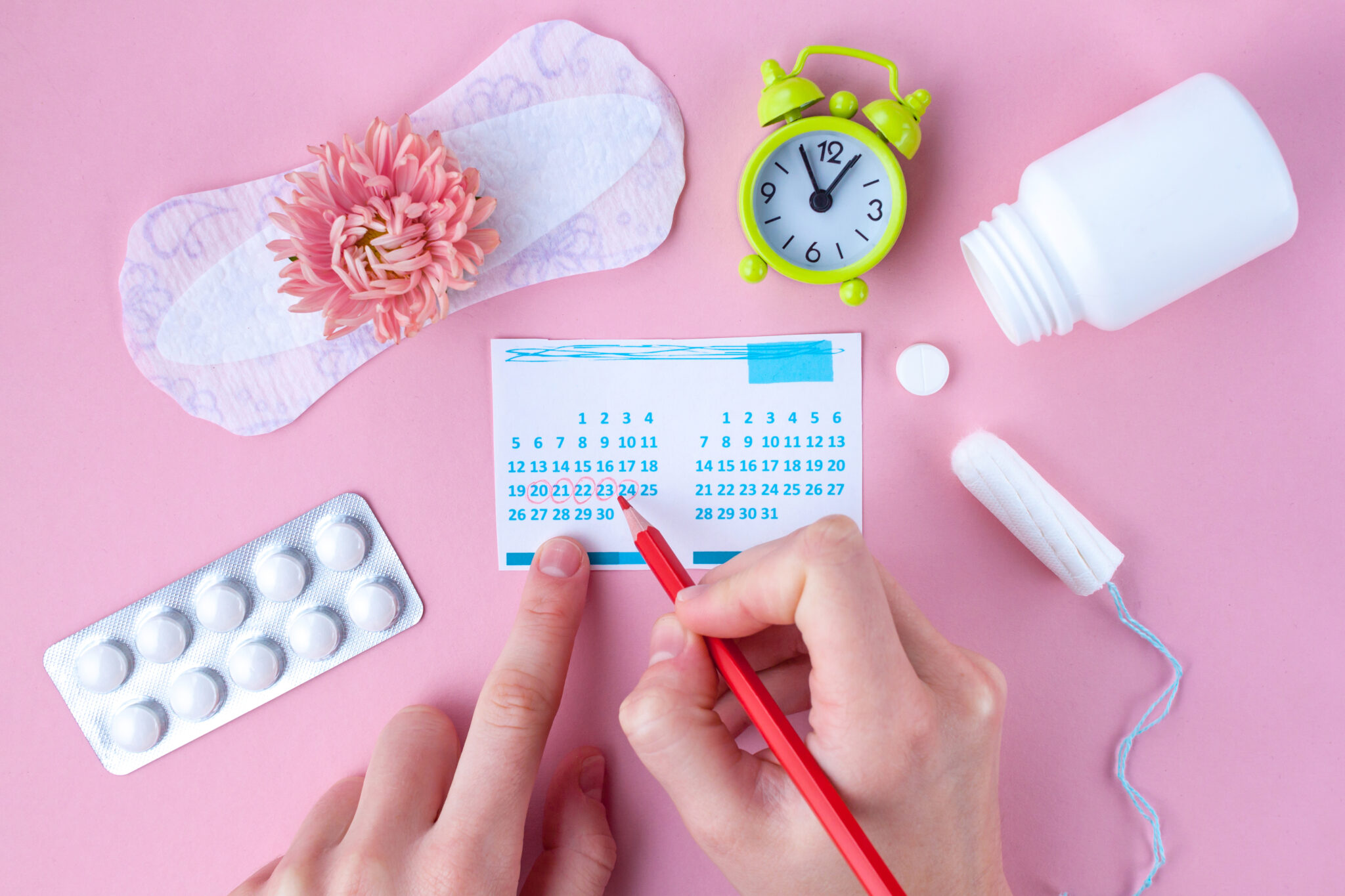 #### What is a menstrual cycle? A woman’s menstrual cycle is the time between the first day of each period. The average menstrual cycle is around 28 days, but cycles can range from 21 to 40 days. A woman’s period, also known as menstruation, is when she bleeds from her [vagina](https://nabtahealth.com/glossary/vagina/) and typically lasts 5 to 7 days. #### What is a period? During a woman’s monthly period her body discards the [uterus](https://nabtahealth.com/glossary/uterus/) (womb) lining thickened in preparation for a fertilised egg. When the egg isn’t fertilised this lining sheds from the [uterus](https://nabtahealth.com/glossary/uterus/), through the [cervix](https://nabtahealth.com/glossary/cervix/), and out of the body through the [vagina](https://nabtahealth.com/glossary/vagina/). A girl’s periods start at any time from age 10 to 15 years old, the average age is 12 years, but everyone is different. Her periods will continue until she is in her 40s to 50s, when her [ovaries](https://nabtahealth.com/glossary/ovaries/) will gradually stop producing female reproductive hormones, leading to [perimenopause](https://nabtahealth.com/glossary/perimenopause/) and then [menopause](https://nabtahealth.com/glossary/menopause/). #### Managing menstrual bleeding Discreet, easy-to-use sanitary products are designed to soak up or collect the menstrual blood released from the [vagina](https://nabtahealth.com/glossary/vagina/). * Sanitary pads: Disposable or washable absorbent padding attached to underwear and changed regularly. Designed in sizes to suit light, medium and heavy flows. * Tampons: Small disposable tubes of absorbent material designed to be inserted into the [vagina](https://nabtahealth.com/glossary/vagina/) to soak up menstrual blood. For hygiene and safety reasons tampons are single-use and should be changed and disposed of regularly. Women should follow labelled instructions for safe tampon use, use the right tampon absorbency, change each tampon every 4 to 8 hours, and never wear a single tampon for more than 8 hours at a time. * Menstrual cups: Washable, reusable medical-grade silicone cups designed to be inserted into the [vagina](https://nabtahealth.com/glossary/vagina/) to catch and collect blood. They should be emptied, washed, and reinserted regularly, and again good hygiene practices are important when using a menstrual cup. * Period underwear: Regular-looking panties designed with absorbent material and a moisture barrier to keep the wearer dry and leak-free. Period panties offer various levels of absorbency and can go in the washing-machine. Some brands also produce period swimwear with built-in leak protection. #### Period hygiene tips The [vagina](https://nabtahealth.com/glossary/vagina/) is a self-cleaning organ and period blood is not contaminated when it exits the body from the womb. However, during a woman’s period the presence of blood, warmth and moisture makes the [vagina](https://nabtahealth.com/glossary/vagina/) and vulva an environment more prone to yeast, fungal and bacterial infections, and bad odour. So keeping a menstrual hygiene routine is important. Healthcare professionals recommend a woman washes her genitals with warm water, not soap, at least twice a day while bleeding, always wiping from front to back. Female hygiene products (tampons, sanitary pads, menstrual cups, period pants) should be changed and disposed of regularly. Reusable and washable sanitary products, such as menstrual cups and period panties, must be rinsed and cleaned thoroughly. #### Tracking periods Everyone is different and every woman’s period and cycle will vary in length, frequency, and flow, sometimes from month to month. It’s useful to get into the habit of tracking periods, either using a period tracker app or a calendar. This helps a woman understand her body’s natural cycle and fertile days. And it’s important to discuss any ongoing changes in cycle length, flow, and frequency with a healthcare practitioner. _How to manage menstrual symptoms_ #### Managing painful periods Period pain (primary dysmenorrhea), cramping in the lower abdomen and back, varies in severity from woman to woman, and sometimes from month to month. Over the counter pain relief, paracetamol, or anti-inflammatory medications such as ibuprofen, will normally relieve painful period cramps. The pains usually last 1 to 3 days, and for some women the cramps might be strong enough to need a day or two in bed. Many women find relief from their period symptoms in gentle exercise, having a warm bath, or putting a hot water bottle, heat pack, or warm flannel on their stomach. Debilitating period pain, also known as secondary dysmenorrhea, is often caused by an underlying medical condition that affects the [uterus](https://nabtahealth.com/glossary/uterus/), such as uterine [fibroids](https://nabtahealth.com/glossary/fibroids/), polycystic ovarian syndrome ([PCOS](https://nabtahealth.com/glossary/pcos/)), [endometriosis](https://nabtahealth.com/glossary/endometriosis/), or pelvic inflammatory disease. #### What is PMS? PMS ([premenstrual syndrome](https://nabtahealth.com/glossary/premenstrual-syndrome/)) or PMT (premenstrual tension) describes the physical and emotional changes caused by the change in estrogen and [progesterone](https://nabtahealth.com/glossary/progesterone/) levels in the [lead](https://nabtahealth.com/glossary/lead/)\-up to a woman’s period. Typical symptoms of PMS include: * Swollen and tender breasts * Mood swings and irritability * Bloating * Acne and greasy hair * Headaches * Low libido To manage PMS women should try to take it easy, eat a healthy diet, do some gently exercise and get plenty of rest. Some doctors may recommend hormonal birth control – the contraceptive pill or Mirena coil – to manage menstrual symptoms. #### What are abnormal periods? If period symptoms are so severe that they interfere with everyday life, or if periods suddenly change (flow is noticeably lighter, heavier or lasts longer, cycles change in length, periods are missed for 3 months or more) it is important to discuss with a healthcare professional. Lifestyle changes and emotional stress can affect a woman’s periods. Other reasons include birth control pills, and underlying conditions such as uterine [polyps](https://nabtahealth.com/glossary/polyps/) or [fibroids](https://nabtahealth.com/glossary/fibroids/), [endometriosis](https://nabtahealth.com/glossary/endometriosis/), polycystic ovarian syndrome ([PCOS](https://nabtahealth.com/glossary/pcos/)), and pelvic inflammatory disease. #### Is it possible to have sex or get pregnant during the period? In a word, yes. Although the risk of getting pregnant is lower while menstruating, it is still important to use birth control to avoid an unwanted pregnancy. #### Continuing with daily life Periods don’t have to get in the way of everyday life. Menstruation is regular part of a woman’s life from [puberty](https://nabtahealth.com/glossary/puberty/) to [menopause](https://nabtahealth.com/glossary/menopause/). Most women will get their period regularly for 30-40 years and managing periods becomes second nature.